


In the ground failure design according to EN 1997-1 [1], a comparison is made between the actions normal to the foundation level and the design values of the resistances. A calculation method according to [1] 6.5.2.2 is used. Annex D of the standard contains an informative example of the analytical determination of the bearing resistance.
Determination of Bearing Resistance for Drained Soil Conditions
The characteristic value of the bearing resistance can be determined according to [1] Annex D, Equation (D.2) for drained soil conditions as:
|
σc |
Stress due to cohesion |
|
σq |
Stress due to foundation depth |
|
σγ |
Stress due to foundation width |
Bearing capacity coefficients (Nc, Nq, Nγ): These factors are calculated considering the soil conditions and the friction angle.
Shape coefficients (sc, sq, sγ): They take into account the geometry of the foundation, such as rectangular or quadratic ground plans.
Foundation base slope coefficients (bc, bq, bγ): The foundation base slope coefficients take into account the inclination of the foundation base α and are always calculated for the ground failure design.
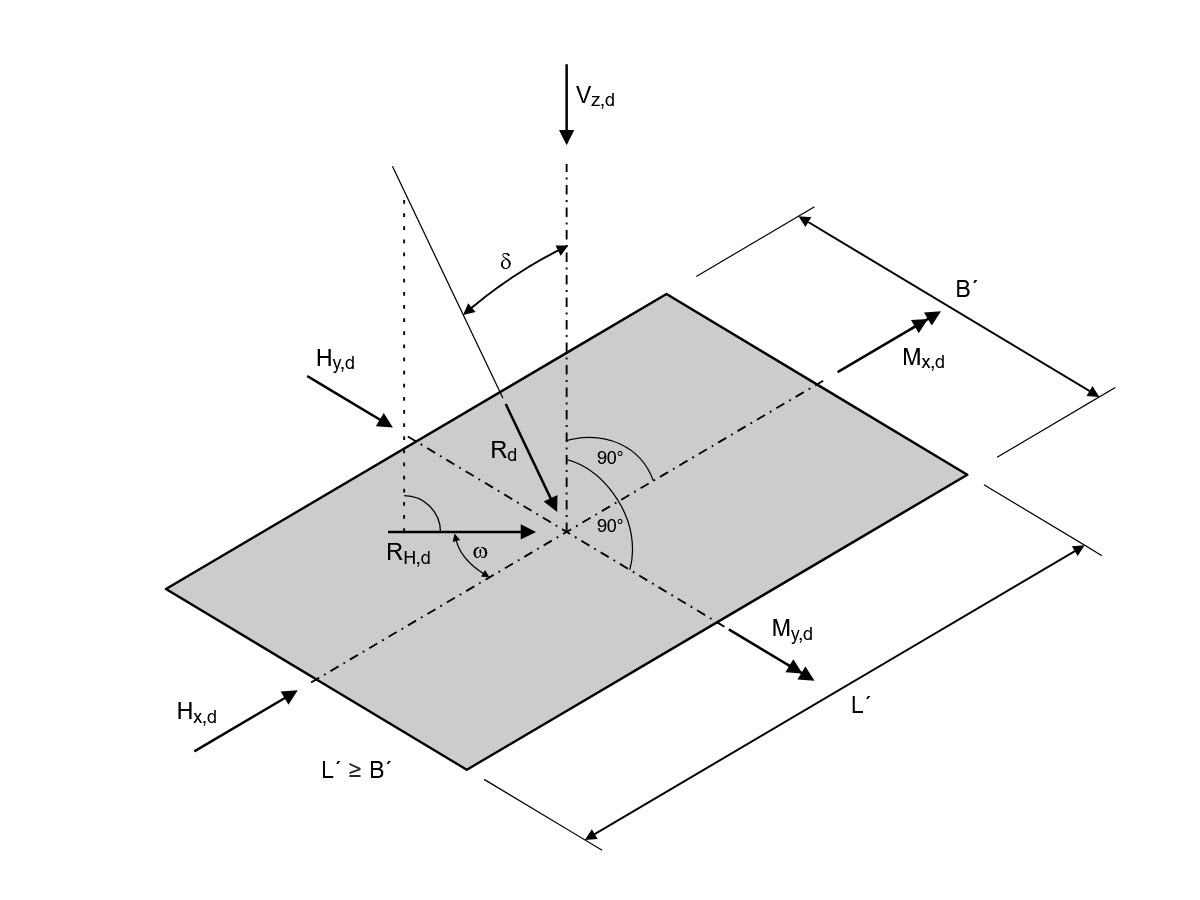
Slope coefficients (ic, iq, iγ): They take into account the effects of inclined loads.
Determination of Bearing Resistance for Undrained Soil Conditions
In the case of undrained soil conditions, the following formula is used:
Design
The design value of the ground failure action is compared with the design value of the bearing resistance: