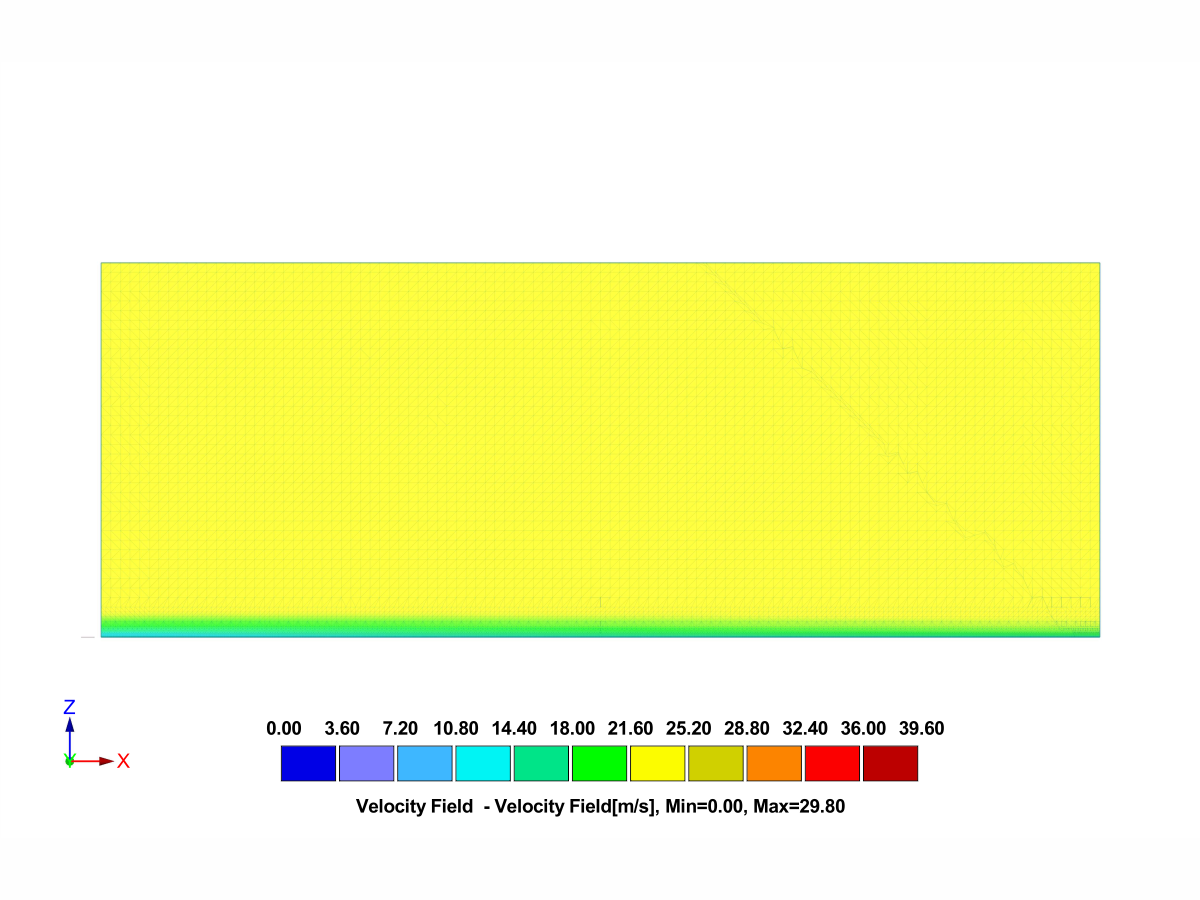
Description
This example is based on the Atmospheric Boundary Layer (ABL) test from the document of the German WTG: Fact Sheet of Committee 3 - Numerical Simulation of Wind Flows, Chapter 9.1 (see references). It is an extension of VE0309 - Atmospheric Boundary Layer Test.
In this case the rough surface boundary condition is used on the bottom wall and the results are compared with the smooth surface. In the following article, the development of a velocity, turbulence kinetic energy, and turbulence dissipation rate are shown for Terrain Category 0 defined in EN 1991-1-4. A vertically anisotropic turbulence acc. to Chapter 6.3.1 and RANS k-ω SST turbulence model is used.
| Fluid Properties | Kinematic Viscosity | ν | 1.500e-5 | m2/s |
| Density | ρ | 1.250 | kg/m3 | |
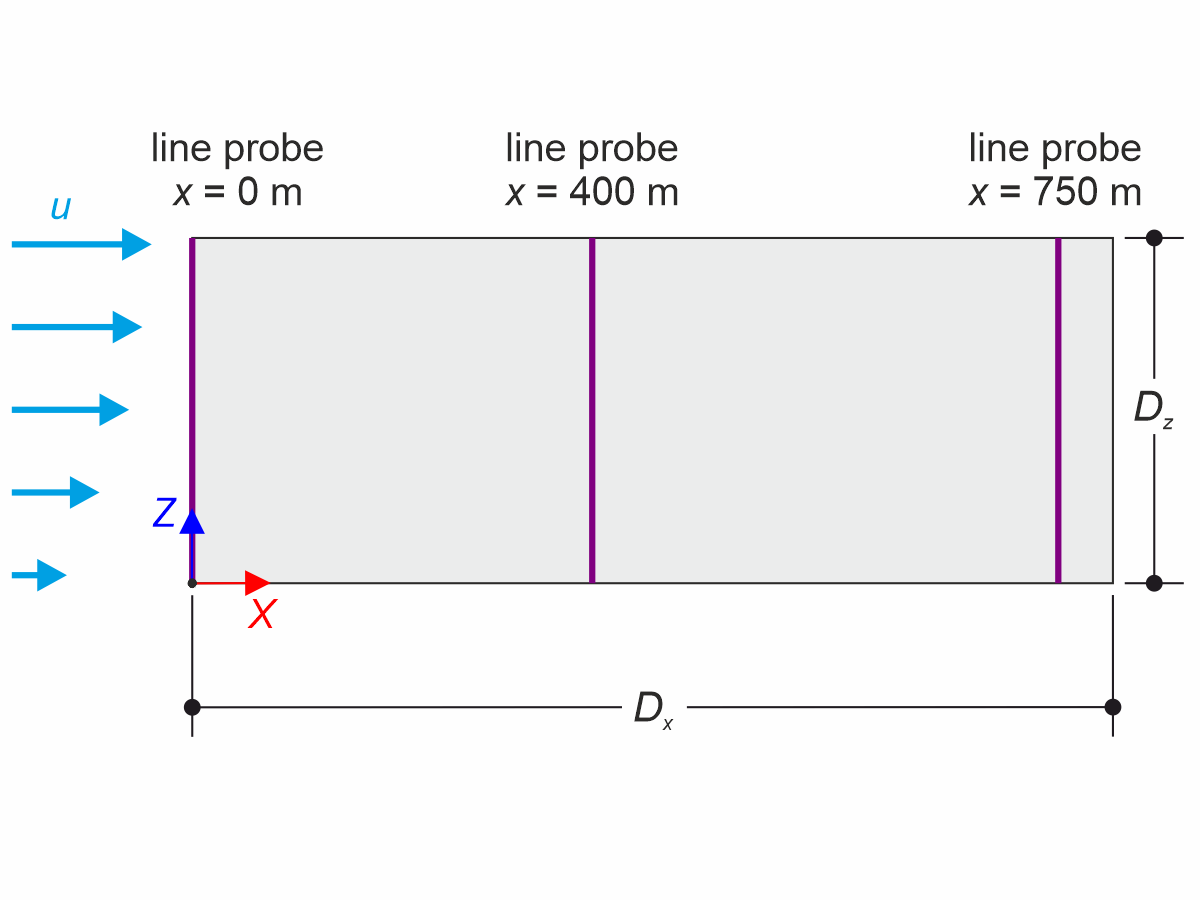
| Wind Tunnel | Length | Dx | 800.000 | m |
| Width | Dy | 80.000 | m | |
| Height | Dz | 300.000 | m | |
| Calculation Parameters | Reference Velocity | uref | 20.000 | m/s |
| Reference Height | zref | 10.000 | m | |
| von Kármán Constant | κ | 0.410 | ||
| Turbulence Viscosity Constant | Cμ | 0.090 | ||
| Roughness Parameters | Aerodynamic Surface Rougness Length | z0 | 0.003 | m |
| Roughness Constant | Cs | 0.500 |
Analytical Solution
An analytical solution is not available. The example provides an overview of the chosen quantity field development in an empty wind tunnel with rough surface on the bottom wall.
The wind speed profile is calculated from the following equation:
where u* is the friction velocity, defined as:
The turbulence k profile is defined according to the following equation:
The turbulence ω profile is calculated according to the following equation:
For the rough surface equivalent, the sand-grain roughness height has to be calculated according to the following formula:
RWIND Simulation Settings
- Modeled in RWIND 3.03.0220
- Steady flow simulation type
- Mesh density is 28%: 2,482,465 cells
- Number of tunnel boundary layers is 10
- The height of the first cell at the bottom is 0.046 m
- y+ ranges from 800 to 1000
- RANS k-ω SST turbulence model
- Inlet boundary condition - ABL v, k, ω; zero pressure gradient
- Tunnel bottom - no-slip boundary condition with wall function for wall constraint on the turbulent viscosity (sand-grain roughness) - nutkRoughWallFunction in OpenFOAM
- Tunnel walls and top - slip boundary condition
- Outlet boundary condition - zero pressure; zero velocity gradient
Results
The comparison of the air flow behavior (development of the velocity, turbulence kinetic energy and turbulence dissipation rate) with rough and smooth surfaces is shown in the following plot.